Public website plus the admin tools your committee runs on — built to outlast committee handovers.
Edition 1 · 2026Build & handover · You own the result
Section 01
The problem this solves.
Grassroots sports clubs run on volunteers, spreadsheets, and Facebook groups. Every few seasons the committee turns over, and the club's history walks out the door with the last secretary's laptop.
63%
Of clubs cite volunteer shortage as their main challenge
1 in 4
Small clubs considered closing in the past year
4–6
Apps families juggle for one club
Sources: Australian Sports Foundation, Clubs Under Pressure (May 2023, n=2,984 community clubs); regional rugby union research, March 2026.
What clubs actually need.
Volunteer-editable. Whoever is on committee this year needs to update the site without hiring a developer.
Real history. Fixtures, results, photos, committee minutes, sponsors, honour roll — kept across committee handovers.
Cheap to run. No monthly bill the next treasurer has to chase up.
Looks legitimate. Parents, sponsors, and the local council take a real website seriously in a way they don't take a Facebook page.
No lock-in. If the relationship with whoever set it up ends, the club still owns the site.
Since December 2025, under-16s can't legally hold accounts on Facebook, Instagram, or TikTok (Online Safety Amendment Act 2024). Clubs that ran their junior comms through a Facebook group now have no way to reach those players — a club-owned site with its own announcements, email, and team-level updates becomes practical necessity, not nice-to-have.
02
Section 02
Why this approach works for clubs.
A site that's built once, owned forever, and shaped around how committees actually work — not how a typical agency would prefer to bill.
1
Built on a shared foundation
Every club site starts from the same proven base. That keeps the build fast and the price honest — you're not paying someone to invent the wheel from scratch, and updates and improvements that come from one club's site can flow to yours.
2
Shaped around your club
The look, the content, the features turned on, the sport-specific bits — all configured to fit your club. You're not stuck with the previous club's logo or someone else's idea of how a fixtures page should work.
3
Yours to keep
The site lives on infrastructure registered in the club's name. The code is in the club's account. If you ever want to take it elsewhere, you can — nothing is held hostage. Committee handovers don't break anything.
What this means in practice.
No SaaS subscription to me. You pay once for what you want built. The small third-party running costs (domain, optional Google Workspace for club email, Cloudflare hosting) are paid by the club directly to those providers, not to me.
No vendor lock-in. Walk away whenever you like — the site keeps running.
No "we don't do that" surprises. Need a new feature later? It's a quoted job, not a "wait for the SaaS roadmap" job.
Survives committee turnover. A new secretary inherits a working website, not a mystery hosting login.
03
Section 03
What's in the core build.
The standard build — what every club gets for the base price. Add-on modules listed on the next page extend this; the core stands on its own.
Core
Public website
Home, About, Contact pages. Works on phones, tablets, and desktops. Looks like a real club website.
Core
Admin area
Password-protected. Committee logs in to update content. Designed to be used by volunteers, not developers.
Core
Photo galleries
Upload photos from the admin, organised by year. Stored safely and served quickly.
Core
Announcements banner
A scrolling banner at the top of the site for time-sensitive news. Set it once, it expires when it should.
Core
Contact form
People fill it out on the site; the message arrives in the admin inbox. No third-party form provider.
Core
Fixtures / draw
This season's schedule. Updates as the season progresses. The "what's on next weekend?" page parents actually want.
Core
Results
Match results, scores, standings. Edited from the admin; visible to anyone.
Core
One stock theme
One of the existing visual themes (see Section 04) applied to your colours. Colours can be tweaked freely.
Admin pages need a login. The public site is fast and stays up.
04
Section 04
Optional modules.
Bolt-ons that extend the core build. Pick what fits your club — and what doesn't fit today can be added later as a one-off purchase whenever the club is ready.
Club Manager
Add-on
The one place to keep everything that isn't match results. Replaces the spreadsheets, email threads, and Google Drive folders that committees usually rely on — and survives the handover when a new committee starts.
What's inside
Committee directory (names, roles, contact)
Meetings + minutes archive
Sponsors register (with renewal dates)
Grants tracker (applied / received / acquitted)
Honour roll (past office bearers, awards)
Compliance & insurance dates
Document library (constitution, policies)
Volunteer hours / roster (optional)
Where the $750 goes
Setup — data structure + admin UI tuned to your roles
Migration — current committee, recent meetings, sponsors
Training — 1-hr session, written runbook, one refinement round
Good fit for: clubs that lose institutional knowledge every committee turnover, or are working toward a community grant application.
Online shop
Add-on
Sell merchandise, canteen pre-orders, fundraiser items, or event tickets directly from the site. Money goes straight to the club via your payment provider. No platform fee on top.
Training — 1-hr session + tested end-to-end with a live transaction
Good fit for: clubs selling jerseys, hoodies, raffle tickets, or running a canteen with online pre-orders.
05
Section 04 (continued)
Optional modules.
Sport-specific features
Add-on
Half of kids drop out of club sport between ages 11–14 and 15–19 (AusPlay). Kids stay engaged when they can see themselves getting better. The sport module turns "we play on Saturday" into a proper season record — fixtures, results, athlete histories — that builds over years instead of getting deleted at season end.
What's inside
Rugby: gala-day fixtures, scores, age-group draws (stock)
Athletics: meets, per-athlete performances, personal bests (stock)
Other codes: custom data model quoted separately — see page 7
Season auto-advance ("next round" updates itself)
Historical ladder / records across seasons
Public results pages + admin entry workflows
Where the $750 goes
Setup — sport-shaped data, your age groups, season schedule
Migration — historical results, where available
Training — 1-hr match-day entry walkthrough
Good fit for: any club whose committee is sick of running results through a Facebook post and a spreadsheet.
Custom theme
Add-on
When a colour swap on a stock theme isn't enough — say, the club has a strong existing visual identity, or wants a completely different layout to the available themes. The stock themes shown in Section 05 are the starting point; this module is the bespoke alternative.
What's inside
Layout designed for your club
Typography choice tailored to the brand
Custom motifs (logo flourishes, dividers)
Bespoke home-page hero
Two rounds of design review
Mobile + desktop renders
Where the cost goes (from $950)
Discovery — call to understand brand identity
Design — two concept rounds (more for fully bespoke)
Note — final price quoted after discovery, not guessed upfront
Good fit for: clubs with a strong brand identity, a designer in-house, or a specific look in mind.
06
Section 04 (continued)
Adapting the platform to your sport.
The Sport-specific module ships with rugby and athletics in production today. For any other code, sport-specific customisation is a separate piece of build-time work — scoped and quoted after the requirements call.
Sport adaptation as a build-time service
Custom build
For codes the platform doesn't yet cover — cricket, AFL, soccer, netball, basketball, hockey, equestrian, gymnastics, and others on request — extending the platform to your sport is a paid, custom piece of work alongside the build. The rate is more favourable than a fully-bespoke build commissioned elsewhere, because your build also extends the platform's supported codes.
How it works in practice
Requirements call maps out your sport's data model
Final scope and price quoted after that call
Sport-specific data structure built for your code
Public results pages styled for your sport's flow
Admin entry workflows that fit how the sport plays
Your sport joins the platform's supported list at launch
Mutually useful: your club gets a result shaped specifically to your sport; the platform gains a new code in its repertoire; future clubs in your sport get a stock build.
Already in production
Rugby — gala-day fixtures, age-group draws, season scores
Athletics — meets, per-athlete performances, personal bests
Codes we'd adapt for you
Cricket & AFL
Soccer (football) & Netball
Basketball & Hockey
Equestrian & Gymnastics
Other codes on request
07
Section 04 (continued)
Optional modules.
Apex / multi-program landing
Add-on
For organisations running multiple sports or age divisions in parallel — for example a club with both juniors and seniors, or a centre running rugby and netball. A top-level page sits above the individual program sites and routes visitors to the right place.
What's inside
Branded landing at the club's main domain
Visual cards for each program
Shared organisation contact details
Apex-level news/announcements (optional)
Separate admins per program
Where the $400 goes
Setup — apex chooser page with branded program cards
Configuration — domain DNS + per-program admin scope
Testing — verified navigation across all programs
Good fit for: clubs whose committee covers both juniors and seniors, or organisations with multiple sport arms.
Sponsors carousel
Add-on
Rotating sponsor logos on the home page (or wherever you want them). Each logo links out, has a contract end date, and can be retired without code changes when a sponsorship lapses. A logo on the front page is a tangible benefit sponsors can point to when renewal comes around.
Migration — current sponsors loaded with logos + end dates
Training — 30-min session on the sponsor admin
Good fit for: clubs with active local-business sponsorship that they want to show off.
Modules don't have to be picked at sign-up. The club can start with the core build and add modules later — each one as a separate one-off engagement, whenever the budget or the need arrives.
08
Section 05
Themes available today.
Each theme is a complete look-and-feel: typography, colours, layout choices. Pick one as part of the core build. Colours can be swapped freely to match your club. Layout changes are custom work.
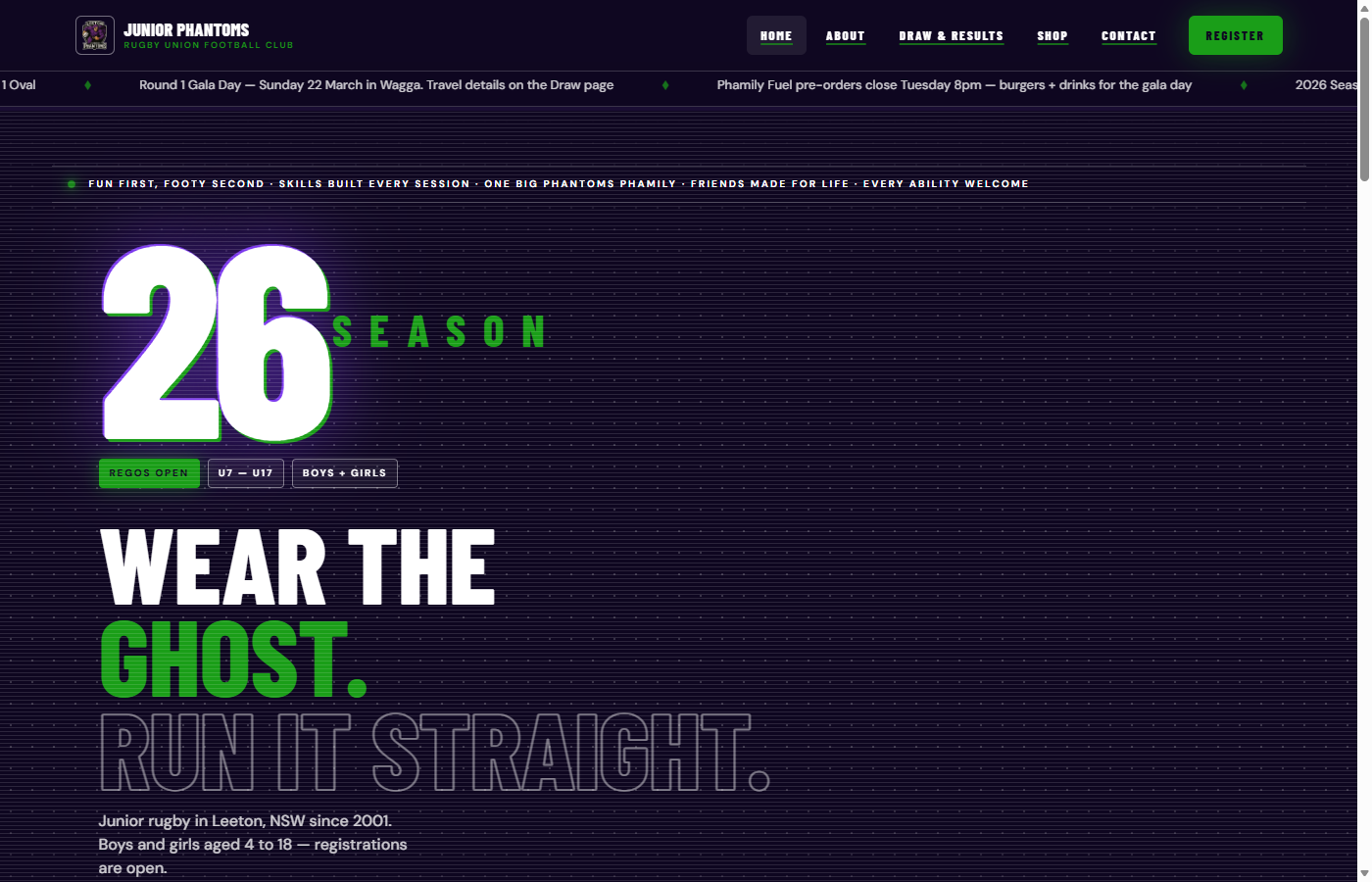
Theme · Stadium
Bold scoreboard energy
Dark background, glowing accent colours, condensed display type. Built for clubs that want their site to feel like match night. In production for a junior rugby club.
Colours swappable · Layout custom
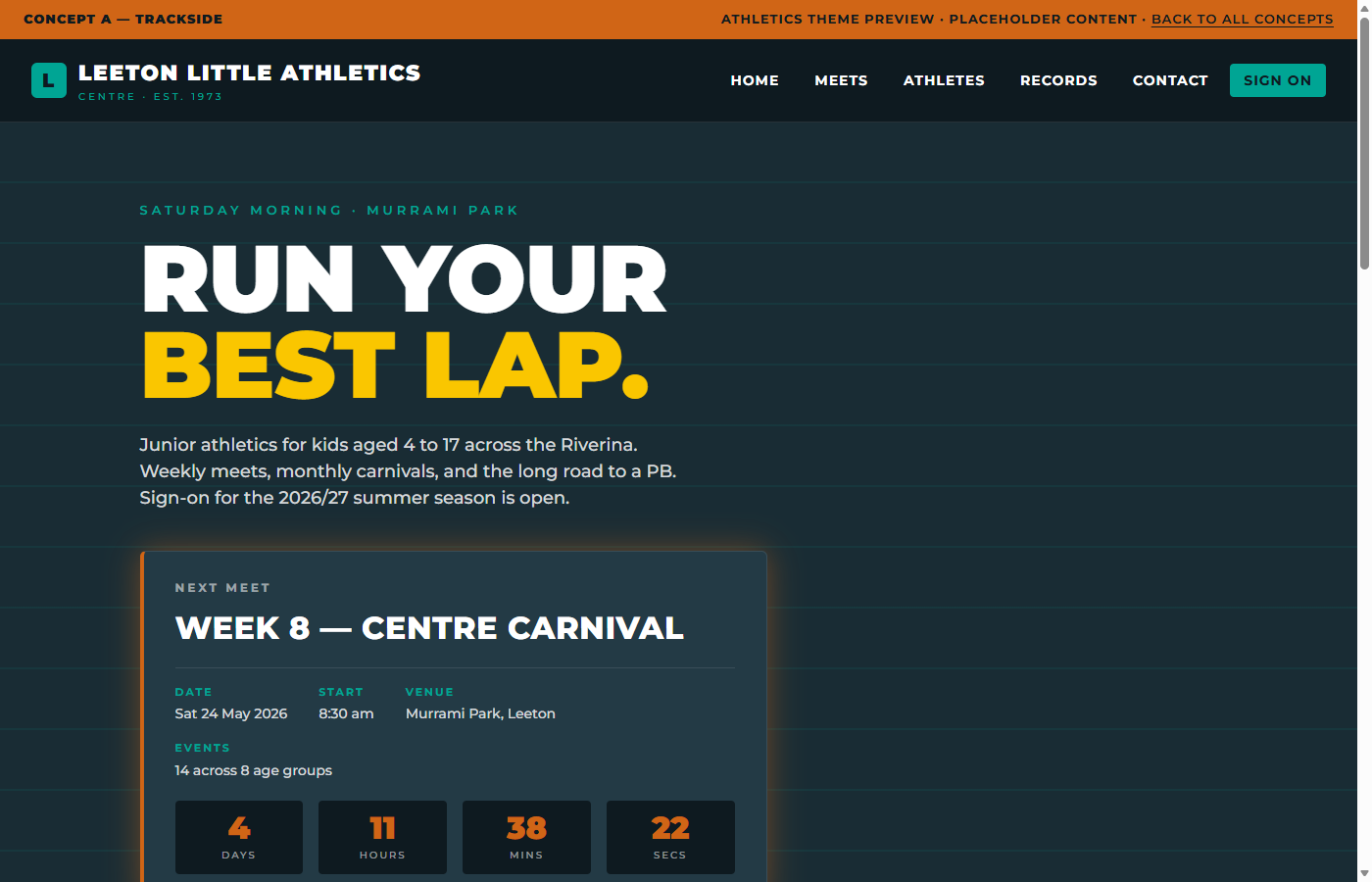
Theme · Trackside
Athletics-aligned, official feel
Designed for athletics clubs. Aligned with Australian Athletics' 2025 brand colours so the site reads as part of the official family. Lane-line motif, countdown to next meet.
Colours swappable · Layout custom
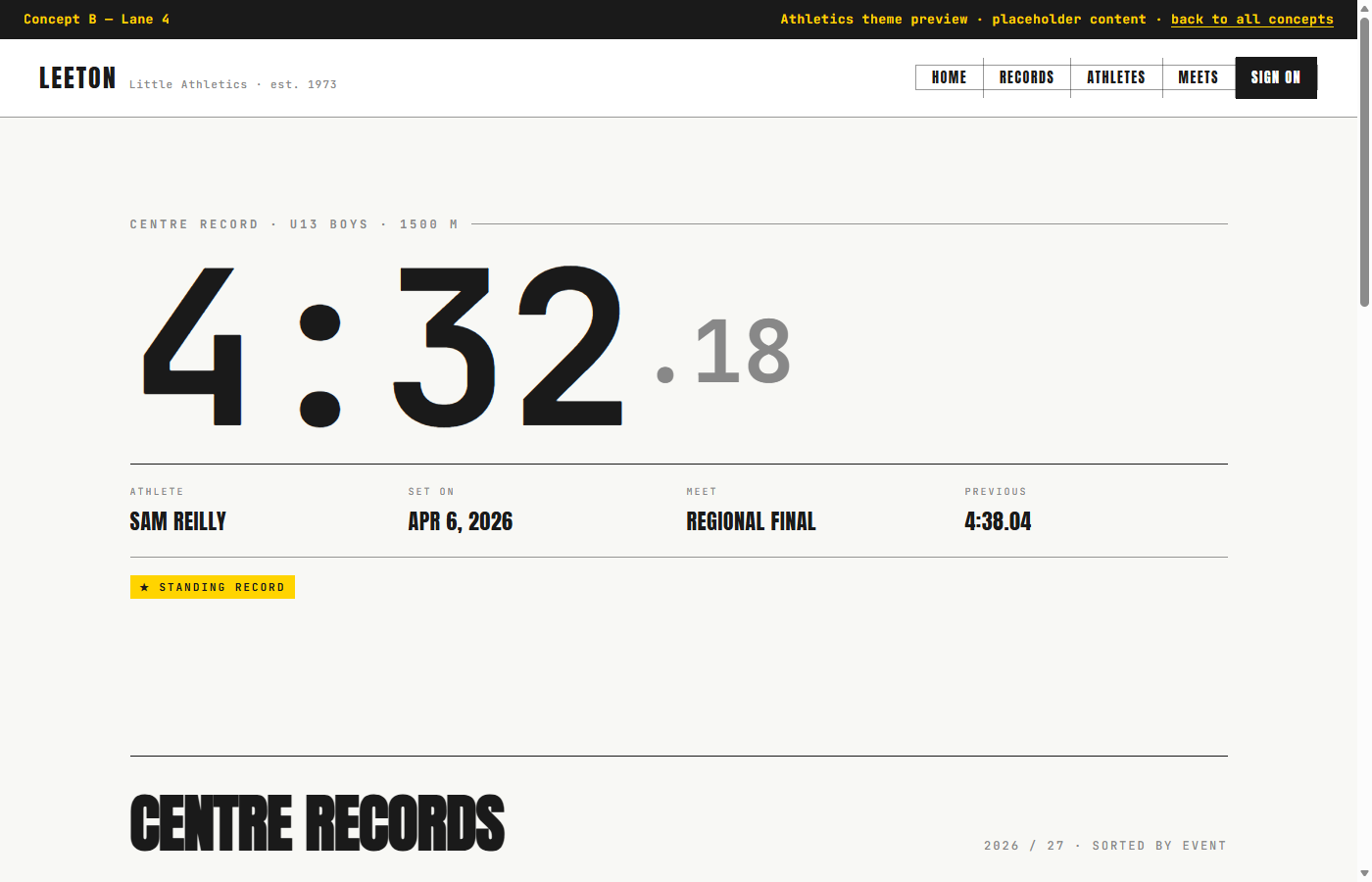
Theme · Lane 4
Numbers-first and precise
Light background, fixed-width numerals, calm and clinical. Best for clubs where times and distances are the point. Reads like a results board.
Colours swappable · Layout custom
Theme · Photo Finish
Editorial and archival
Black-and-white photo treatment, medal-gold highlights, serif body text. Suits clubs with rich photography and a sense of their own history.
Colours swappable · Layout custom
Custom layouts are quoted as a separate piece of work — typically when none of the stock themes is close enough to the club's identity, or when the club has a specific layout idea (e.g. a magazine-style home page).
09
Section 06
What it costs.
One-off pricing. Modules priced individually and can be added at any time — at sign-up or years later. All prices exclude GST.
Core build
Standard website (Section 03) on one stock theme with your colours
Match-day tools, results, season records. Includes rugby or athletics data model; other codes require custom adaptation (page 7)
$750
Online shop module
Merchandise & canteen items via your payment provider
$550
Apex / multi-program landing
Top-level page for clubs running parallel programs
$400
Sponsors carousel
Rotating sponsor logos with admin upload + retire workflow
$350
Custom theme
Bespoke look-and-feel beyond a colour swap on a stock theme
from $950
All prices exclude GST and are one-off. Module fees cover labour to get each one running — setup, data wiring, integration, training — not a licence to use code. The code ships with every build. Third-party running costs (domain ~$30/yr, optional Google Workspace ~$15/mo, Cloudflare free tier, payment-platform percentages e.g. Square's) are paid directly to those providers.
Typical bundles, grant context, and the optional ongoing support are on the next page.
10
Section 06 (continued)
Bundles, grants & ongoing.
Common combinations clubs choose, where the money typically comes from, and the (optional) ongoing support.
Typical packages.
Starter ($2,500). Core build only — a club that wants a real website but isn't running its own results or shop yet.
Active club ($4,000). Core + Club Manager + Sport-specific. The "we want it all working from day one" package.
Established club ($4,550). Active club + Online shop. Adds online merchandise and canteen pre-orders.
Everything ($6,250). Core plus every module, including a custom theme. Caps the total spend for a club that wants no surprises down the track.
Packages above assume a stock-supported sport (rugby or athletics). For other codes, add a separately-quoted sport adaptation — see page 7.
Sport & Recreation NSW, ClubGRANTS, and many council community grants fund one-off digital infrastructure work — the Core build is sized to fit within the typical grant amounts these programs award.
Ongoing support (optional).
A small retainer covers platform updates, occasional admin help, and quoted feature work as the club grows. Not required — the site runs without it. Available as a separate arrangement.
Hosting and infrastructure detailed on the next page.
11
Section 07
Built on proven infrastructure.
Club sites are deployed onto Cloudflare — the same network behind around a fifth of all websites on the internet, used by Fortune 500 companies, governments, and major banks. The same network, on a free tier most clubs never pay for.
~20%
Of all websites run on Cloudflare's network
300+
Cities worldwide with Cloudflare data centres
100%
SSL/security included on the free tier
Why this matters for a sports club.
Always-on. Served from data centres on every continent — no 2am outage calls for volunteers.
Secure by default. DDoS protection, SSL, and bot filtering come standard.
Free for almost every club. The Cloudflare free tier covers far more traffic than a community club site will ever use.
Room to grow. Paid services unlock cleanly — billed directly by Cloudflare, on a card in the club's name, not through me.
Optional upgrades the club can explore later.
AI-assisted content. Workers AI drafts match reports, social posts, and meeting summaries.
Smart form protection. Turnstile blocks bot submissions without captchas.
Web analytics. Privacy-respecting visitor stats — no cookie banners, no Google Analytics.
The same reliability and security that runs major banks is free for community clubs to use.
12
Section 08
What you need to bring.
Most clubs already have everything on this list except maybe the domain — and that's the easiest thing to sort.
Accounts & admin
✓
A Gmail (or Google-linked) email for the club
Something like yourclub@gmail.com. Used to register hosting and any services the build needs. Google login means the next committee inherits the site with just the email password — no separate logins to track.
✓
A credit or debit card for the Cloudflare account
Cloudflare requires a card on file even though your site sits inside the free tier. No billing is expected — the card is there for the account, not to be charged. Treasurer's debit card or a club Visa works fine.
✓
A domain name (if you have one)
Something like yourclub.com.au. If the club has one, we'll use it. If not, we'll help register one. Typically $10–30/yr, paid directly to the registrar.
Branding & content
✓
Your logo and colours
Existing logo in any format (PNG, JPEG, PDF). Hex codes if you know them, or a screenshot of your Facebook page is enough to match.
✓
A handful of good photos
Five to ten sharp photos of the club in action — training, match day, presentations. Phone photos are fine. Used for the home page hero and gallery.
✓
Some words about your club
Short text on who you are, where you train, and how to reach you. Write it yourself or give me a quick brief and I'll draft it.
One person
✓
A nominated committee member as the main contact
One named person, empowered to make decisions during the build. Two decision-makers roughly doubles the timeline.
What you do NOT need to bring
Any tech experience · a web designer or developer · a monthly hosting budget · an existing website to migrate · a separate business account · anything you've paid for previously.
13
Section 09
How a new club gets stood up.
Two calls, a few weeks of build, then a deploy. The longest wait is usually the club gathering brand assets and deciding on a domain.
1
Requirements call
What features the club wants, which sport, whether any modules are needed, brand assets, the domain.
2
Branding & setup
I pick the closest stock theme (or quote a custom one). Club colours and logo are applied. Initial content is drafted with the club's input.
3
Build & deploy
I set up everything under the club's own accounts, deploy the site, and load any initial data the club has.
4
Handover
The club gets admin logins, a written guide, and a walk-through of the admin area. Everything is in the club's name from this point on.
5
Ongoing (optional)
Support retainer with me if you want one; otherwise the site keeps running on its own with just the small third-party costs (domain, optional Workspace, Cloudflare). Modules can be added later as separate one-off engagements.
The whole process from first call to live site typically takes 3–6 weeks, depending on how quickly the club can decide on branding and gather content (see Section 08 for the short list of what you'll need to bring).
14
Section 10
What I do and don't include.
Clarity beats vague. Here's exactly what's in scope, and what isn't.
Included
Core public + admin website (Section 03)
Any modules you've picked (Section 04)
One stock theme with your colours
Accounts and infrastructure set up in the club's name
Initial deploy and content load
Written runbook for the admin area
Walk-through session at handover
Full source code and ownership
Not included
Online registrations payment processing — typically handled by the parent sporting body
Membership database — typically handled by the parent sporting body
Email marketing campaigns
Mobile apps
Multi-club shared platforms
Live in-game scoring (results are entered after the match)
Original graphic design (we work with existing brand assets)
Photography
Content writing
Search-engine marketing
For the short list of things the club needs to provide for the build to start, see Section 08 — What you need to bring.
15
Get in touch
Let's talk about your club.
A 20-minute conversation is enough to work out whether this service fits your situation. No commitment to proceed.
Want to see the contract upfront? Just ask, and I'll send the standard services agreement (full terms, IP transfer, data handling, payment cadence) so there are no surprises when the engagement starts.
Sports club websites · Edition 1 · 2026Brochure version